

Music Theory and Composition

Ryan Leach is an Award Winning Composer for film and tv. His music has been heard on Every major Network. His clients includes Disney, Mtv and Netflix.
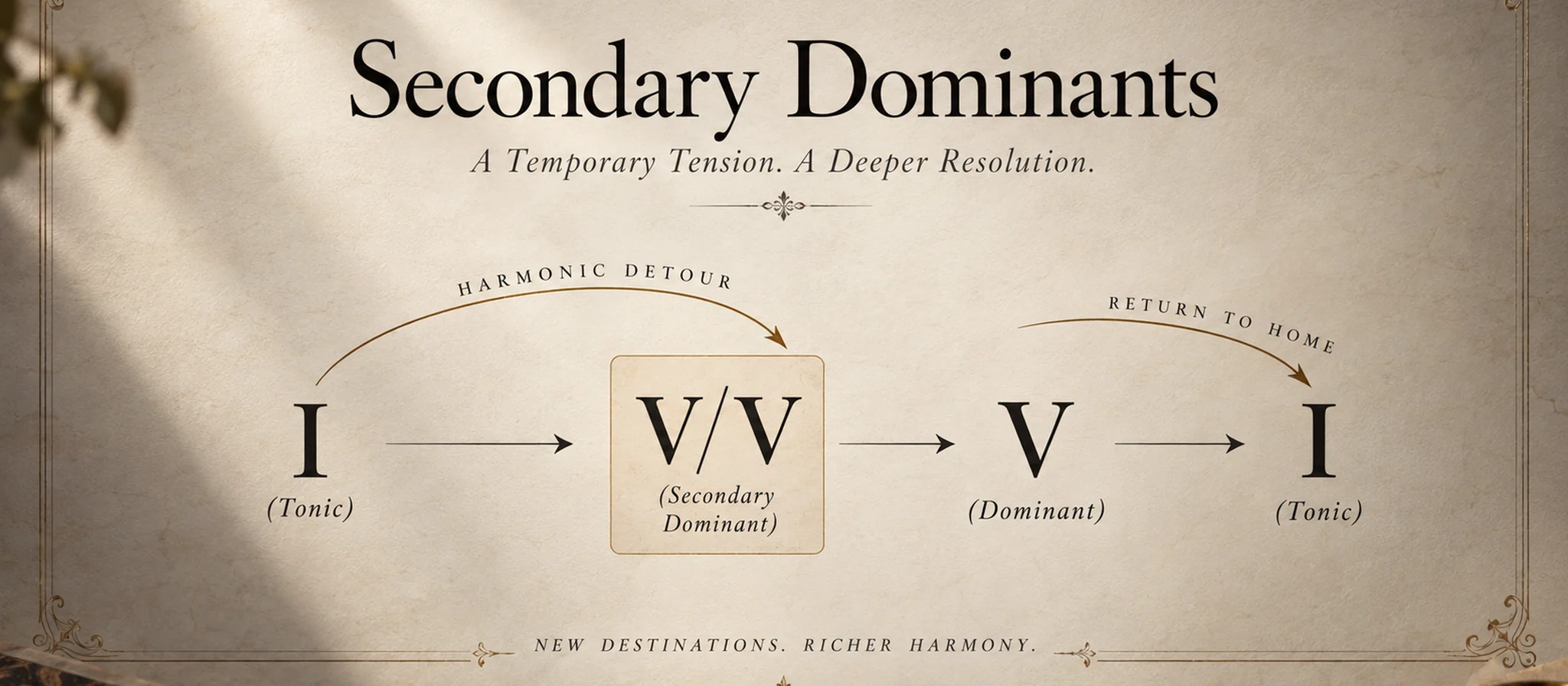
A secondary dominant is a dominant chord that points at a chord other than the tonic. It borrows the pull of the V–I resolution — one of the strongest moves in tonal harmony — and aims it at any chord you choose, so that the chord arrives with the same sense of inevitability as a cadence on the home key. That single idea is behind a great deal of what makes film, game and anime harmony feel alive: momentum, colour, a chromatic bass line, a climax that lands. This guide explains what secondary dominants are, how to find them for any target, when to use them and when to leave them out, and how they relate to their close relatives, the tritone substitute and the leading-tone chord, drawn from the harmony material in Pillars of Composition, Pillars of Composition II and The Legend of Otoe.
In any key, the V chord — the dominant — has a special relationship with the tonic. In C major, G7 wants to resolve to C, and that pull comes from the leading tone: the B in the G chord sits a half step below C and wants to rise into it. Preceding the tonic with its dominant is a satisfying way to set up an expectation and then deliver on it.
A secondary dominant uses exactly that gravity to lead somewhere else. Take a plain I–ii–V–I in C major: C–Dm–G–C. Now imagine, for a moment, that D minor were the tonic. What would its V chord be? A major chord a fifth above it: A major, or A7. Put that A7 in front of the D minor — C–A7–Dm–G–C — and the D minor arrives with the same pull that C normally gets from G. A7 is the secondary dominant of ii, written V/ii and read "five of two".
Two things follow from this. First, secondary dominants are non-diatonic chords: A7 contains a C♯ that does not belong to C major. They are, in a sense, the first chords you meet that come from outside the key. Second, the target chord is being treated, briefly, as a tonic. Music theory calls this tonicization. The music does not change key — C is still home — but for a beat or a bar the ear is invited to hear the target as home instead.
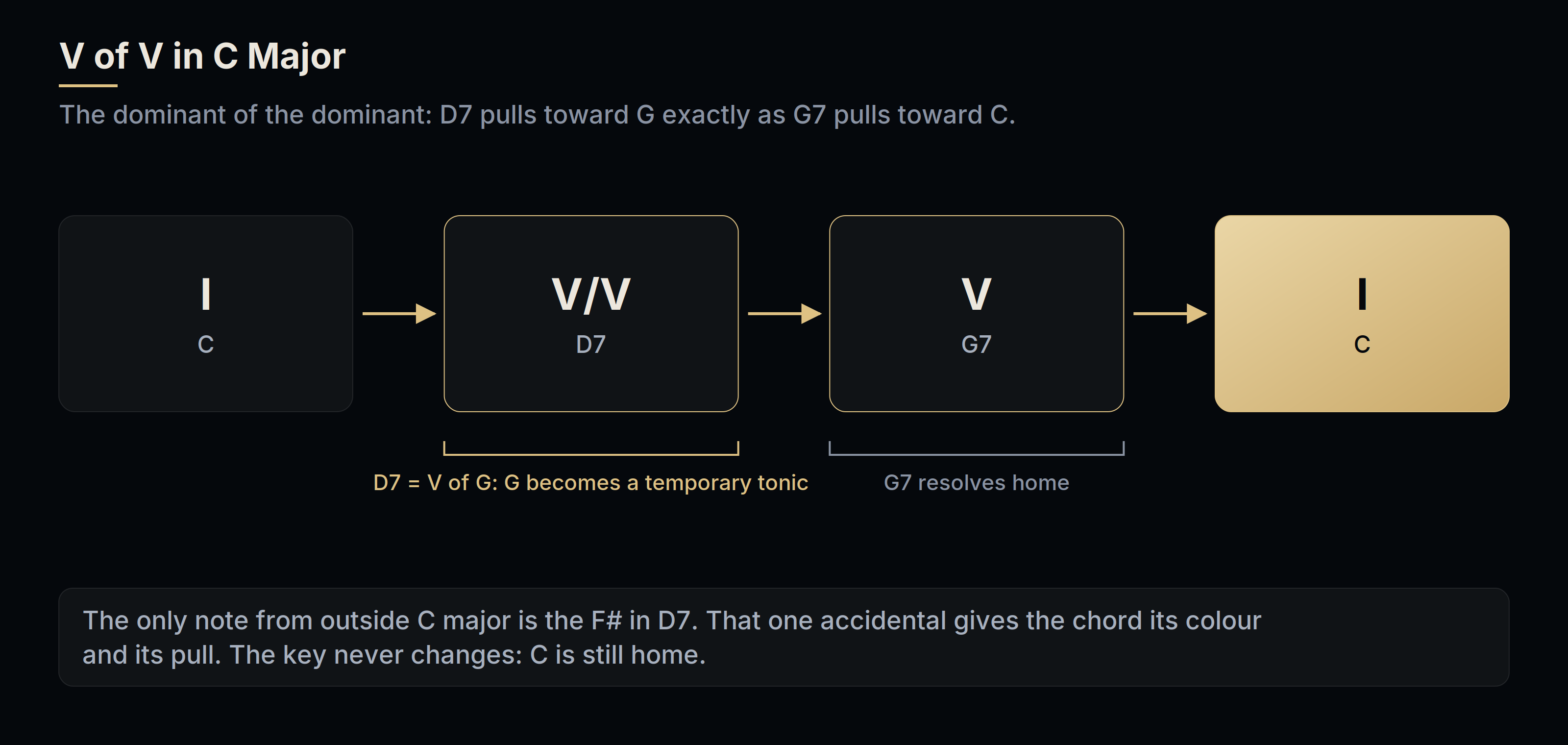
The most common example is the dominant of the dominant, V/V. In C major that is D major (or D7) leading to G. It is a standard classical move for setting up a half cadence, and you will hear it in themes of every era: I–V/V–V, then either a pause on the V or a resolution home.
At some point, using only diatonic chords becomes limiting and a little bland. Secondary dominants are the first way out, and the good news is that they are easy to find: every diatonic chord except vii° has its own dominant, a major triad or dominant seventh a fifth above it.
In C major:
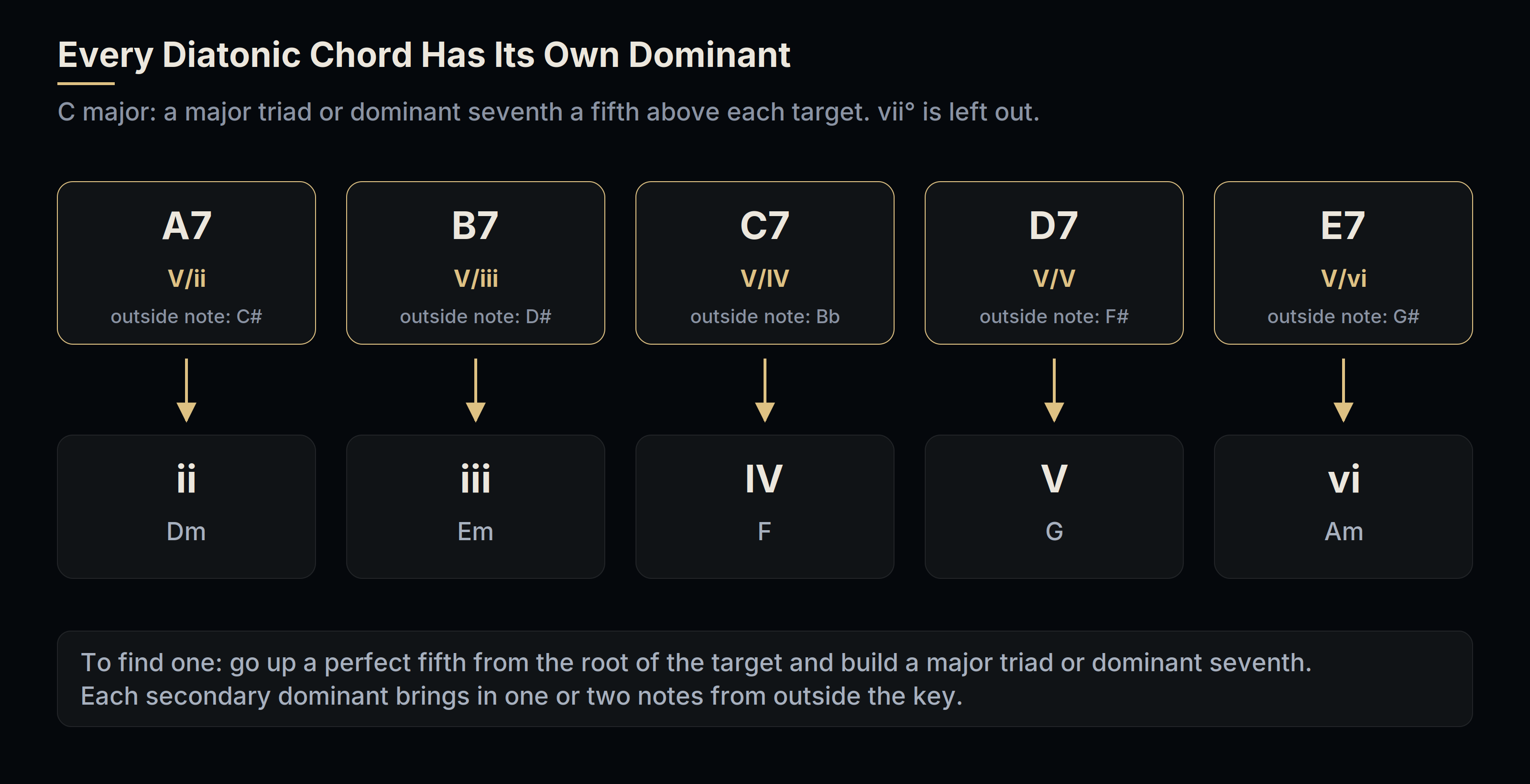
Each of these introduces one or two notes from outside the key — the C♯ in A7, the D♯ in B7, the B♭ in C7, the F♯ in D7, the G♯ in E7 — and that accidental is what gives the chord its colour. The diminished vii° is normally left out: there is no useful dominant of a diminished chord, and we tend to ignore it in this context.
The same list works in minor keys; the targets change quality but the principle does not. In A minor you can aim a dominant at the iv (D minor, from A7), at the VI (F major, from C7), at the III (C major, from G7), and so on. When you are hunting for a spicy chord in a minor-key theme, working through the possible targets — "what is the dominant of my IV chord? of my V?" — is a reliable way to find one.
Knowing the list is not the same as knowing where a secondary dominant will work. Three checks decide it.
Does the melody allow it? A secondary dominant adds a chromatic note, and that note has to agree with whatever the melody is doing on that beat. If your target is F and the dominant of F is C7, C7 contains a B♭ — and if the melody has a prominent B natural at that moment, the chord will fight it. In that case the C7 is not a candidate, however tempting the target. The reverse is also true: with dominant-function chords you are free to add ninths and thirteenths, so if the melody note before a C target is an A, a G9 will carry it comfortably. Look at the melody first, then choose the chord.
Does the moment want tension? A secondary dominant creates a bit of extra pull and then releases it, which is why it works so well on the way into a climax. In a diatonic piano piece, the highest note of the melody can be set up with a secondary dominant right before it, so that the peak lands with an extra charge; the same chord in a soft, gentle theme may simply be unnecessary. When you are deciding, ask what the passage is for.
Is the cadence already doing that job? If the V chord is part of a IV–V–I that establishes the key for the first time, or of a ii–V–I, it is doing structural work, and swapping it for something more colourful weakens the cadence. Secondary dominants belong on the smaller waypoints. If you want more of them, double the harmonic rhythm instead — turn a bar of one chord into two half-bar chords — and put the secondary dominant in the second half.
The Legend of Otoe — Composing Music for Anime and JRPGs Harmonic functions, cadences, secondary dominants and the chord progressions of anime and JRPG music, taught from the first chord to a finished piece. Explore the course
If a single dominant can be aimed at a target, so can a whole cadence. Any chord can be preceded by its own ii–V or IV–V — a two-chord approach that makes the arrival even clearer. In C major, aiming at A minor, that is Bm7♭5–E7–Am: a minor-key ii–V–i inside a major-key progression. Aiming at F, it is Gm7–C7–F.
This is a signature of Japanese game and anime harmony. Joe Hisaishi's One Summer's Day from Spirited Away precedes its targets with full ii–V and IV–V approaches; the theme for Kakariko Village in Ocarina of Time ends with a secondary dominant aimed at the ii chord, which then kicks off a fresh ii–V–I. And the Nichijou progression, named after the opening of the anime, is built almost entirely from secondary dominants and secondary ii–V–Is chained together.
A very simple version of the idea produces surprisingly rich results. Take two diatonic destinations, say IV and vi, and tonicize each of them in turn: IV, then a secondary dominant or ii–V aimed at vi, then vi, then an approach back to IV. Eight bars of nothing but two target chords and the roads between them.
Drama and energy. Variations of a progression that use secondary dominants generally add more drama. That makes them ideal for the later stages of a piece — the moment when you are repeating a progression the listener already knows and need a little extra push. In a Royal Road progression (IV–V–iii–vi), for instance, you can tonicize the ii chord before the closing cadence, or replace IV–V with a ii–V aimed at the iii. Our Royal Road guide walks through those modifications.
Chromatic bass lines. Put a secondary dominant in first inversion and its third — the new leading tone — sits in the bass, a half step below the target. E7 over G♯ walking into A minor; F♯7 over A♯ walking into B minor. The bass climbs chromatically into the target chord, which is a large part of why progressions with secondary dominants sound so purposeful, and why bass players like them.
Transitions. Because a secondary dominant treats its target as a temporary tonic, it is a natural pivot into a new section. If the B section of a piece starts on the IV chord, ending the A section on V/IV — the I chord with a minor seventh added — hands the music straight into it. In a sonata development, the secondary dominant at the end of a four-bar phrase is what carries the phrase into the next key so the whole thing can be sequenced.
Journeys. Chain secondary dominants and you get a chain of descending fifths: each dominant resolves into a chord that becomes the next dominant. Follow it and you travel steadily away from the home key; break it wherever you like, by treating one of the resolutions as a new tonic, and you have modulated. Our guide to the circle of fifths covers those gestures in detail.
For any target, the secondary dominant is one of three chords that do the same job. The others are its tritone substitute and its leading-tone chord.
The tritone substitute, or sub five, is the dominant seventh whose root lies a tritone away: D♭7 instead of G7 for a C target. It shares the same defining tritone as the dominant it replaces, so it resolves just as smoothly, and it resolves down by a half step. The two reasons to choose it over a plain secondary dominant are colour, and a smooth bass line — Dm–D♭7–C makes a chromatic descent where Dm–G7–C would leap. Our tritone guide explains why it works.
The leading-tone chord is a diminished triad or diminished seventh built a half step below the target: Bdim or Bdim7 for C, C♯dim for D minor. It works exactly like a secondary dominant — leading tone on the bottom, resolving up; diminished fifth resolving down into the third of the target — but in some contexts it can sound a little old-fashioned. Our guide to diminished chords covers the details.

So for a C major target you have G7, Bdim or D♭7, in any inversion. The options are somewhat limited, which is useful: it keeps the toolbox small enough to actually use.
Secondary dominants also combine with functional substitution. If a progression has two bars of IV in a row, replace the second with ii — same subdominant function — and put V/ii in front of it. What was F–F is now A7–Dm: two chords with direction where there was one chord standing still.
Pillars of Composition II Reharmonization with functional substitution, secondary dominants, sub fives and leading-tone chords, taught by building a complete piece module by module. Explore the course
Some borrowed chords end up sounding like secondary dominants whether you intend it or not. A dominant seventh built on the tonic — I7, borrowed from Mixolydian — will usually be heard as V/IV, unless the surrounding harmony is bluesy enough to make it a colour in its own right. A ♭VI7 in a major key is technically a borrowed chord, but in most contexts it simply sounds like a secondary dominant aimed at ♭II. And ♭III7 tends to read as V of ♭VI. The lesson is that any dominant seventh other than V carries the expectation of a resolution a fifth below, and you can either honour that expectation or deliberately frustrate it — but the ear will register which one you chose.
The most common mistake with secondary dominants is using too many. One, two, perhaps three in a passage add interest and motion. Much more than that and the progression starts to sound as if it is jumping randomly from key to key — or, if you keep going, like bebop, which is a fine sound but rarely the one a cue is asking for. Think of it like seasoning a dish: too much spice and it tastes only of spice.
There are also styles that want none at all. A Viking theme that is meant to feel clean, solid and safe avoids secondary dominants entirely, along with seventh chords and borrowed chords, because chromaticism of any kind belongs to a different world. Even in a happy, grounded earth theme, a B7 aimed at E minor can be a little too spicy — the plain B minor may serve the character better. Knowing the tool includes knowing when to put it down.
For the wider context these moves live in, see our complete guide to chord progressions for composers.
Our Music Composition & Orchestration Courses
Our Music Production Courses
Our Music Trailer Courses
What is a secondary dominant in simple terms? A dominant chord that resolves to a chord other than the tonic. In C major, A7 resolving to D minor is a secondary dominant: A7 is the V chord of D minor, and it pulls toward D minor the way G7 pulls toward C.
What does V/V mean? "Five of five": the dominant of the dominant. In C major the dominant is G, and the dominant of G is D major or D7. V/V is the most common secondary dominant and a standard way of setting up a half cadence.
What is tonicization? Treating a chord other than the tonic as a temporary home, usually by preceding it with its own dominant. The key does not change; the target simply sounds, for a moment, like a tonic.
How do you find the secondary dominant of a chord? Go up a perfect fifth from the root of the target and build a major triad or dominant seventh there. For D minor, that is A or A7; for F, it is C or C7.
Can you use a secondary dominant in a minor key? Yes. Any chord in the key can be preceded by the dominant a fifth above it — in A minor, C7 before F, G7 before C, A7 before D minor.
What is the difference between a secondary dominant and a borrowed chord? A secondary dominant comes from the key of its target and exists to resolve into it. A borrowed chord comes from a parallel mode and is used for its colour; it does not necessarily resolve anywhere. Some borrowed chords, like ♭VI7, end up sounding like secondary dominants anyway.
How many secondary dominants should a progression have? One to three in a passage is usually enough. More than that and the harmony starts to sound as if it is wandering between keys.
Learn with Master The Score
Courses on composition, orchestration, music production, trailer music and sound design, from composers writing for film, games and media. Students also get exclusive discounts on leading sample libraries and plugins.
Discover all courses →


Online education for media composers — orchestral writing, trailer music, mixing and more, taught by working professionals.


