

Music Theory and Composition

Ryan Leach is an Award Winning Composer for film and tv. His music has been heard on Every major Network. His clients includes Disney, Mtv and Netflix.
The circle of fifths is the one diagram in music theory that keeps paying off for the rest of your life. It tells you every key signature, which keys are close to each other, which chords want to follow which, and how to get from one key to another without the seams showing. This guide covers both halves: how the circle is built and read, and then what film, game and anime composers actually do with it, drawn from the harmony material in The Legend of Otoe and Pillars of Composition II.
The circle of fifths is a diagram that arranges all twelve major keys (and their relative minors) in a circle, so that each key is a perfect fifth above the one before it. Start at C at the top and move clockwise: G, D, A, E, B, F#/Gb, Db, Ab, Eb, Bb, F, and back to C. Twelve steps of a fifth bring you home.
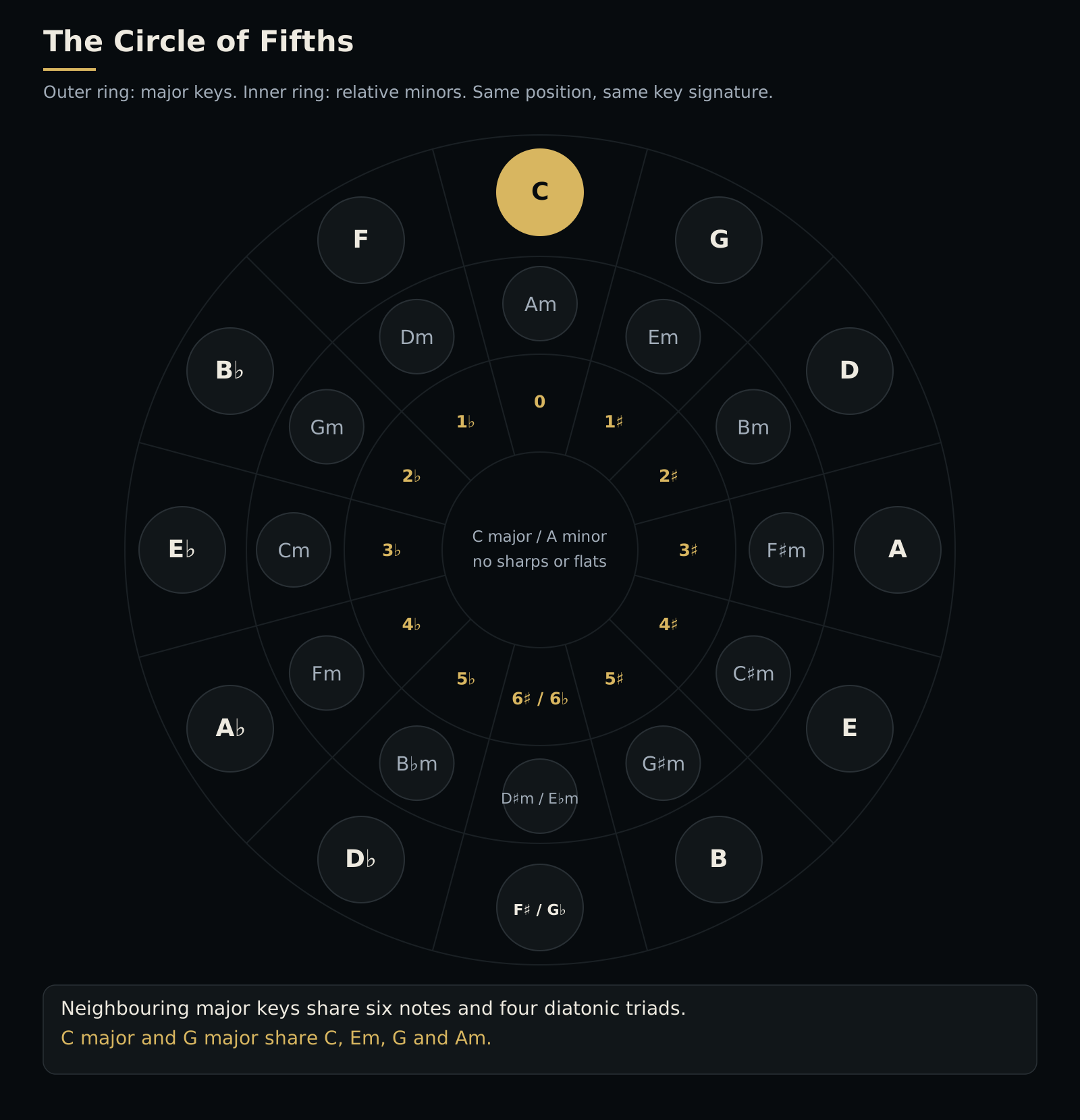
That arrangement is not decorative. Two keys that sit next to each other on the circle differ by exactly one accidental, share six of their seven notes, and share four diatonic triads. For example, C major and G major share C, Em, G and Am. Major keys on opposite sides share fewer notes and no diatonic triads. So the circle is a map of tonal distance: close on the circle means close in sound. Everything else the circle does, from key signatures to modulation to chord progressions, follows from that.
Read the other way, counterclockwise, each step is a perfect fourth, which is why the same diagram is sometimes called the circle of fourths. It is one circle; the name only says which direction you are looking.
Moving clockwise from C, every step adds one sharp:
Moving counterclockwise from C, every step adds one flat:
At the bottom of the circle the two sides meet: F# major and Gb major are the same key spelled two ways. (B major and Cb major, and Db and C# major, overlap in the same way; most charts show the simpler spelling.)
Notice the order in which sharps appear: F, C, G, D, A, E, B. That is itself a chain of fifths. The order of flats is the same list backwards: B, E, A, D, G, C, F. The circle is fifths all the way down.
Because each step adds one accidental, the circle answers "how many sharps does this key have?" by counting steps from C. Two practical tricks make it faster than counting:
Going the other way, from key to signature, you read the accidentals off the circle in order: a key with four sharps has the first four of F, C, G, D, A, E, B.
The circle itself does not change with the clef. C major has no sharps or flats whether you read it in treble or bass clef, the order of sharps is still F, C, G, D, A, E, B, and both tricks from the previous section work unchanged, because they are about note names, not staff positions. What changes is where the key signature sits on the staff.
In bass clef, the pattern of sharps or flats keeps its familiar zigzag shape but is written one line lower than in treble clef. The first sharp, F#, moves from the top line of the treble staff to the fourth line of the bass staff; the first flat, Bb, moves from the middle line down to the second line. If you can picture a treble-clef key signature, you can read the bass-clef version by sliding the same shape down one line, and the circle still tells you which key it is.
For composers there is a second reason the bass clef matters here: the circle of fifths is mostly heard in the bass. Root movement by falling fifths, G down to C, D down to G, is carried by the bass line, so when you write a descending-fifths chain or a ii–V–I, the bass clef is where the gesture actually lives. Cellists, trombonists and bass players spend their lives with this motion under their fingers, and pianists meet it every time the left hand walks a progression home. Reading the circle fluently in bass clef pays off the moment you start orchestrating.
Every major key shares its key signature with one minor key, its relative minor, whose tonic sits a minor third below. Charts usually show these as an inner ring: A minor inside C major, E minor inside G, D minor inside F, and so on around the circle. The inner ring is a second circle of fifths, offset by three semitones from the outer one.
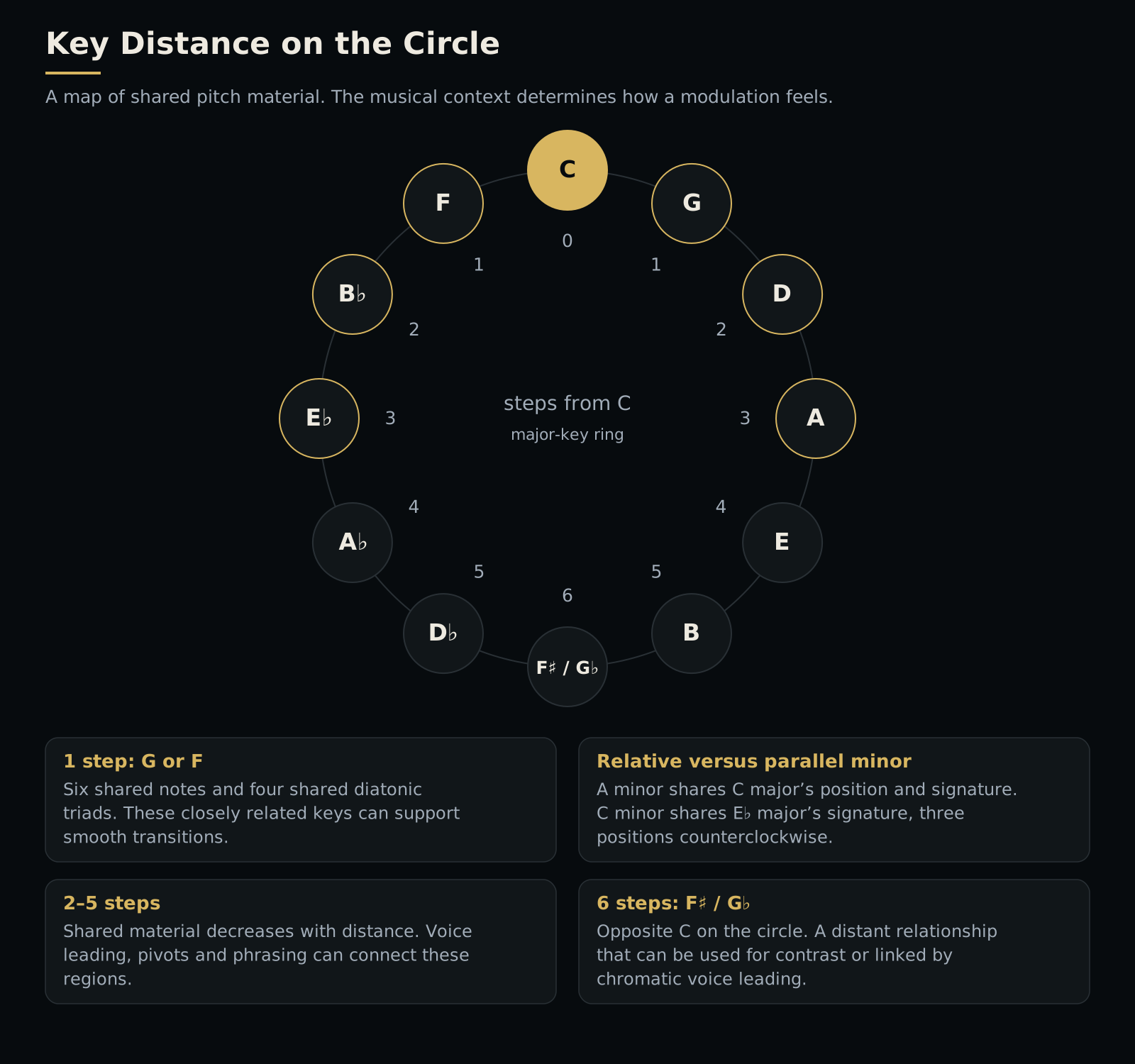
Two terms are easy to confuse here. The relative minor shares the key signature (C major and A minor). The parallel minor shares the tonic (C major and C minor) and sits three steps counterclockwise on the circle, which is why moving between parallel keys feels like a real change of colour while moving between relative keys feels like a change of mood inside the same world. Both relationships are used constantly in film and game scoring, and the circle shows you at a glance which is which.
So far the circle has been about keys. Its more useful face, for a composer, is as a map of chords.
Take C major and label the diatonic chords with Roman numerals. The three primary chords, I, IV and V, are C, F and G: the tonic and its two neighbours on the circle. Every key works the same way, which is one reason a chart is worth having on the wall. Pick any key, and the two chords either side of it are its subdominant and dominant.
The circle also predicts the strongest chord movements in tonal music. A root that falls by a fifth, G to C, D to G, A to D, produces the sense of resolution that harmony is built on; V to I is the most familiar case. Line several of these up and you get a chain of descending fifths, each chord resolving into the next. On the chart above, every link of that chain is one step counterclockwise. Lay the chain over the diatonic chords of a key and it reads: vii°, iii, vi, ii, V, I. If you want the wider picture of how progressions carry emotion, our guide to chord progressions covers the ground; here we stay with what the circle itself gives you.
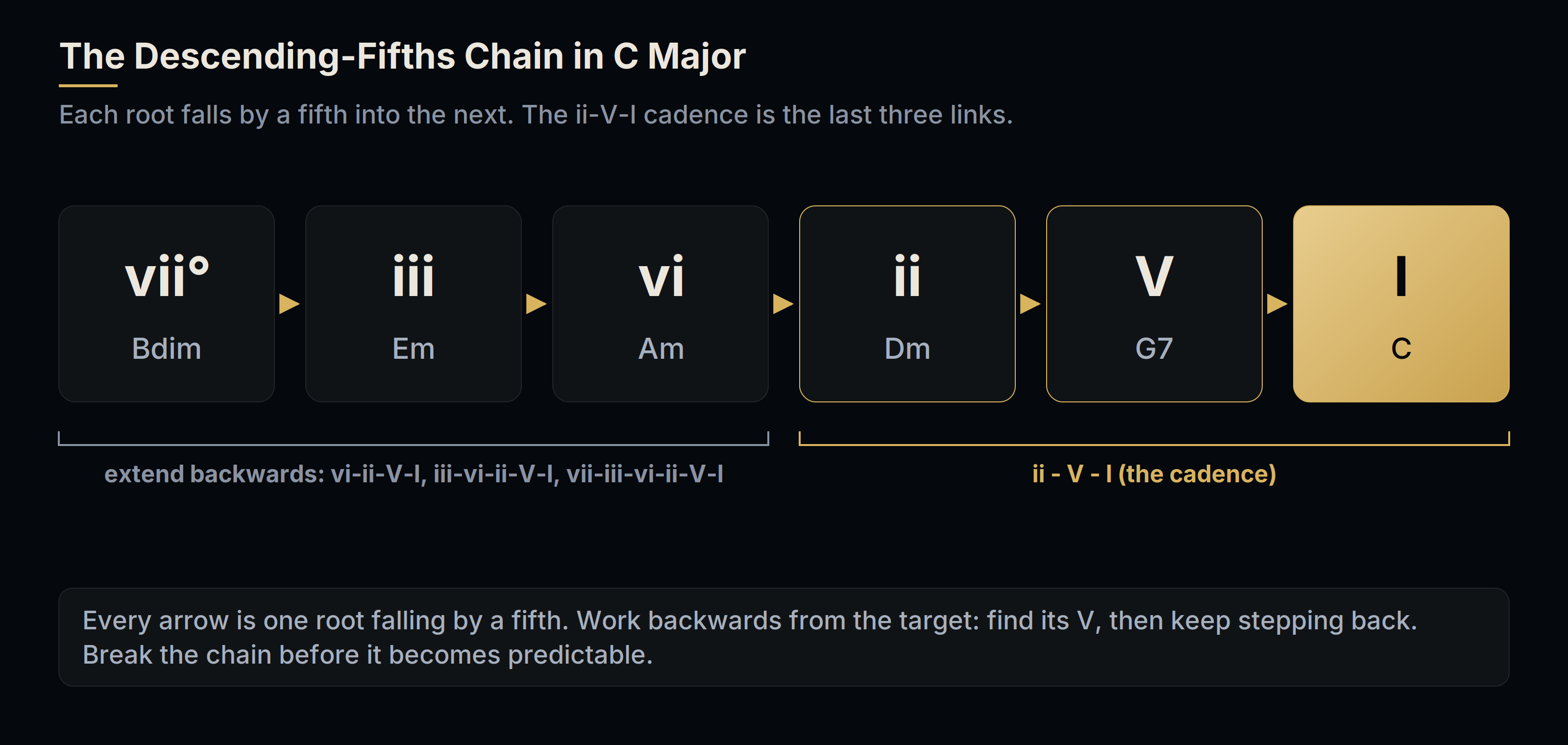
The ii–V–I is a central cadential progression in jazz and the last three links of this chain. It can be extended backwards to vi–ii–V–I or iii–vi–ii–V–I. Descending-fifth sequences also occur widely in earlier tonal music. A longer chain can build momentum towards a cadence, while its actual effect depends on chord quality, voicing and rhythm.
Japanese game and anime composers use this device constantly. A well-known example is the opening theme of Neon Genesis Evangelion: the progression starts on IV, runs iii–vi–ii–V, and then uses a secondary ii–V to land back on IV. That last move, a ii–V aimed at a chord other than the tonic, is the same logic applied one level down, and it is where circle-of-fifths thinking starts to feel like a technique rather than a diagram.
The Legend of Otoe: Levels 2 & 3 Circle-of-fifths gestures, tritone substitution and the harmony behind anime and JRPG music, with a full sketch written in every level. Explore the course
In a score, the chain rarely appears as a textbook vii–iii–vi–ii–V–I. What composers use is what we call a circle-of-fifths gesture: a run of root movements by fifth that drives the music towards a target chord. Three habits make it work.
Work backwards from the target. Decide where you want to land, say a C major chord, then ask what its V is (G7), what could come before that (D), and keep stepping backwards. The chain can start wherever you happen to be, in whatever key or tonal centre you are in; it is a way in from anywhere. Once the chain rolls forward it has an inevitability that a sequence of unrelated chords never has.
Break the chain on purpose. A diatonic descending-fifth sequence can remain entirely in its home key. A chromatic chain can move through new tonal regions, especially when its chords establish new local tonics. You can leave it whenever you want, but you need to be deliberate if you want to end up where you began. In a chase sketch from the third level of the Otoe course, the harmony lifts through the circle twice, C to F, then Eb to Ab, and then stops: a third lift would have been obvious and predictable, so the music holds on Ab and starts moving down instead, standing on the dominant before the next section. In this example, two lifts and a break avoid a third predictable repetition.
Use it where it belongs. A circle-of-fifths gesture is functional, forward-moving harmony. It is exactly right for a chase, a build, or the approach to a cadence, and exactly wrong for a scene that is meant to sit in a mood. The same Otoe sketch planned circle-of-fifths gestures for its "doom" section and then cut them, because the story no longer had a chase in it. Knowing when not to use the device is part of using it well.
The circle scales up from chords to whole sections. In a sonata-style development, or any long cue that needs to wander and return, the question is which keys to pass through. One reliable approach is to fix the chord that brings the main theme back, typically the dominant seventh of the home key, and work backwards around the circle from there: precede the G7 with D, before that A, before that E, before that B. If the piece's secondary key is G major, you use the versions of those chords that belong to G major, and the whole development feels related to what came before.
The same plan works in the minor. Before the G7 you could have Ab, before that Eb, before that Bb, perhaps F minor before that, all drawn from C minor. Same skeleton, entirely different colour. The circle is not the only way to plan a development, and it should not be used every time, but it works reliably and it is a good place to start experimenting.
Transitions use the circle in miniature. If you know the chord you are leaving from and the V chord you need to arrive at, count the bars in between and fill them with a logical progression that gets you there: a chain through the circle of fifths is the classic choice, a series of rising thirds is another. The specific choice matters less than the fact that a harmonic sequence takes the listener through several harmonies in a way that is both comprehensible and interesting.
Pillars of Composition II Sonata form, key planning, transitions and reharmonization, taught by building a complete piece module by module. Explore the course
Because neighbouring keys share six of their seven notes and four diatonic triads, the circle tells you which modulations will feel smooth and which will feel dramatic. A move to the dominant or subdominant is one step and can be especially smooth. The relative minor shares the key signature and occupies the same angular position on the inner ring: A minor sits inside C major. The parallel minor shares the tonic but changes three key-signature accidentals: C minor sits three positions counterclockwise from C major. A move to the opposite side of the circle, a tritone away, is a jolt, and is used precisely when a jolt is wanted.
A fifth relationship also makes a modulation easier to sell. In a transition between two major themes, moving into the minor side of the circle for a moment, C# minor to F# minor, then arriving on a suspended chord that resolves to the new dominant, makes the change of key feel like the natural next step rather than a cut. A sus4 resolving to a dominant seventh is one of the most dependable ways to land a modulation, and the circle tells you which dominant to aim for.
Guitarists tend to meet the circle of fifths later than pianists, because open-position chord shapes make some keys feel like "guitar keys" and others feel foreign. The circle explains why: E, A, D and G sit next to each other, so songs in those keys share chords and shapes, while Eb or Ab are four or five steps away and need a capo or barre chords. Reading the circle as a chord map, with the I chord and its two neighbours, is the fastest way to work out the chords of any key, and the descending-fifths chain is the reason so many progressions move the way they do up and down the neck.
For the wider harmonic context these moves live in, see our complete guide to chord progressions for composers and our look at the Royal Road progression, an anime progression that can be extended with a ii–V–I turnaround.
Our Music Composition & Orchestration Courses
Our Music Production Courses
Our Music Trailer Courses
What is the circle of fifths used for? Reading and remembering key signatures, finding the relative and parallel minor of any key, working out the chords of a key, building chord progressions that resolve strongly, planning which keys a piece passes through, and choosing modulations that feel smooth or dramatic.
Why is it called the circle of fifths? Because each step around the circle is a perfect fifth. After twelve fifths you arrive back at the starting note, which is why the diagram closes into a circle.
Is the circle of fourths the same thing? Yes. A perfect fifth up is the same as a perfect fourth down, so reading the circle counterclockwise gives fourths. It is one diagram with two names.
How do I memorize the circle of fifths? Learn the order of sharps, F C G D A E B, which is a chain of fifths. Keep that separate from the sharp-key sequence: G, D, A, E, B, F♯, C♯. The order of flats is B, E, A, D, G, C, F. After that, the two tricks for reading key signatures (last sharp plus a half step; second-to-last flat) cover everything.
Is the circle of fifths different in bass clef? No. The keys, the order of sharps and flats, and the reading tricks are identical in every clef. Only the position on the staff changes: in bass clef the same key-signature pattern is written one line lower than in treble clef.
What is the relative minor on the circle of fifths? The minor key that shares a key signature with a major key, three semitones below it: A minor for C major, E minor for G major, and so on. Charts show the relative minors as an inner ring.
How do composers use the circle of fifths for chord progressions? As a chain of descending fifths. The ii–V–I cadence is the end of that chain, and it can be extended backwards (vi–ii–V–I, iii–vi–ii–V–I) for more momentum. Composers also work backwards from a target chord to build a run of fifths that drives towards it, and break the chain deliberately before it becomes predictable.
Can the circle of fifths help with modulation? Yes. Keys next to each other on the circle share most of their notes, so moving between them is smooth; keys far apart share little, so the change is dramatic. The circle also shows which dominant chord to aim for when landing in a new key.
Learn with Master The Score
Courses on composition, orchestration, music production, trailer music and sound design, from composers writing for film, games and media. Students also get exclusive discounts on leading sample libraries and plugins.
Discover all courses →


Online education for media composers — orchestral writing, trailer music, mixing and more, taught by working professionals.