

Music Theory and Composition
September 1, 2026
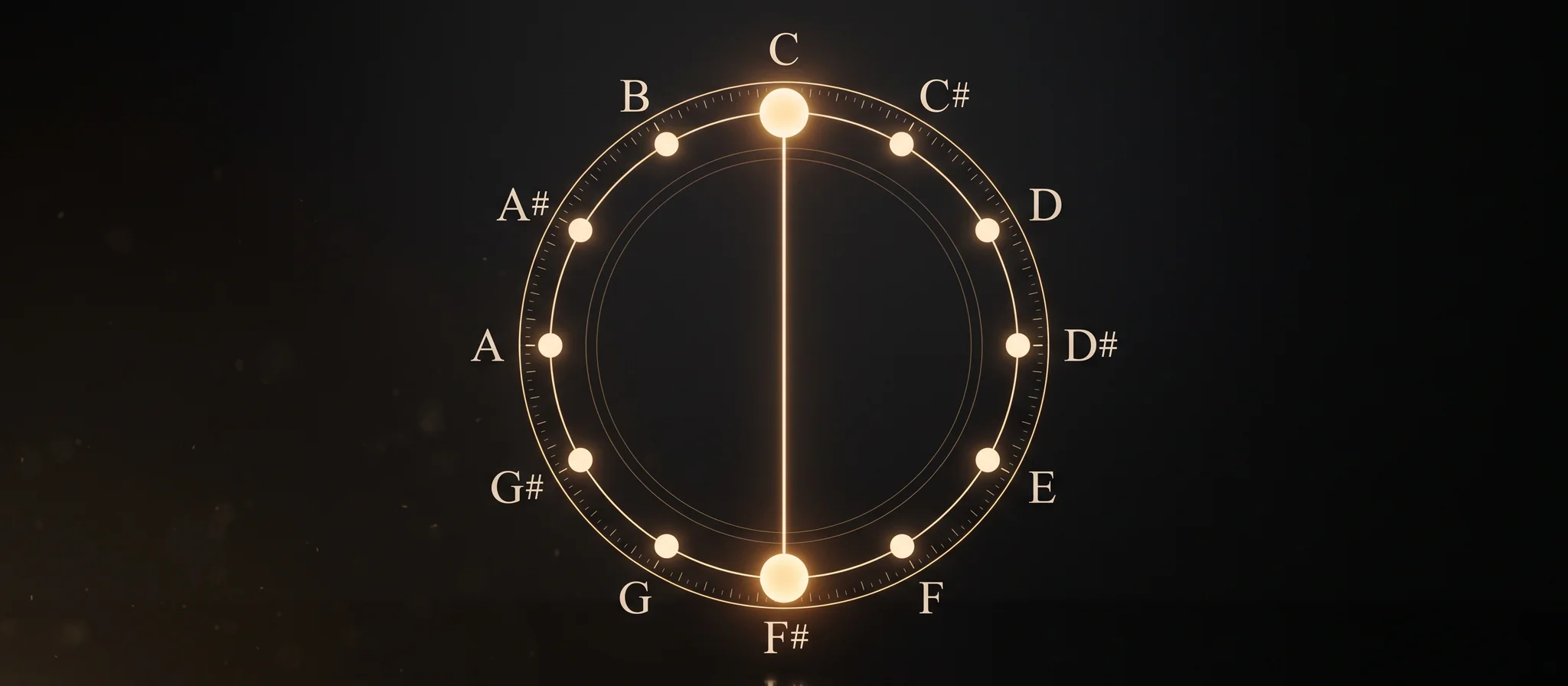
The tritone has a reputation. It has been called the devil's interval, it sits at the center of nearly every dominant chord, and it shows up wherever music needs tension, instability, or a touch of menace — from horror scores to jazz reharmonization to anime openings. This guide explains what a tritone actually is, why it creates such a strong pull, and the many ways composers put it to work, drawing on material from the Master The Score course curriculum.
A tritone is an interval that spans three whole tones — six semitones, or exactly half an octave. In C major, the classic example is the distance from F to B. Depending on how it is spelled, the same distance can be written as an augmented fourth (F to B) or a diminished fifth, but the sound is identical.
That "half an octave" detail matters more than it first appears. The tritone is the only symmetrical interval: it is identical when inverted. A third becomes a sixth when inverted, a fourth becomes a fifth — but a tritone inverted is still a tritone. Flip B and F so that B is on top, and the distance between the two notes is still six semitones.
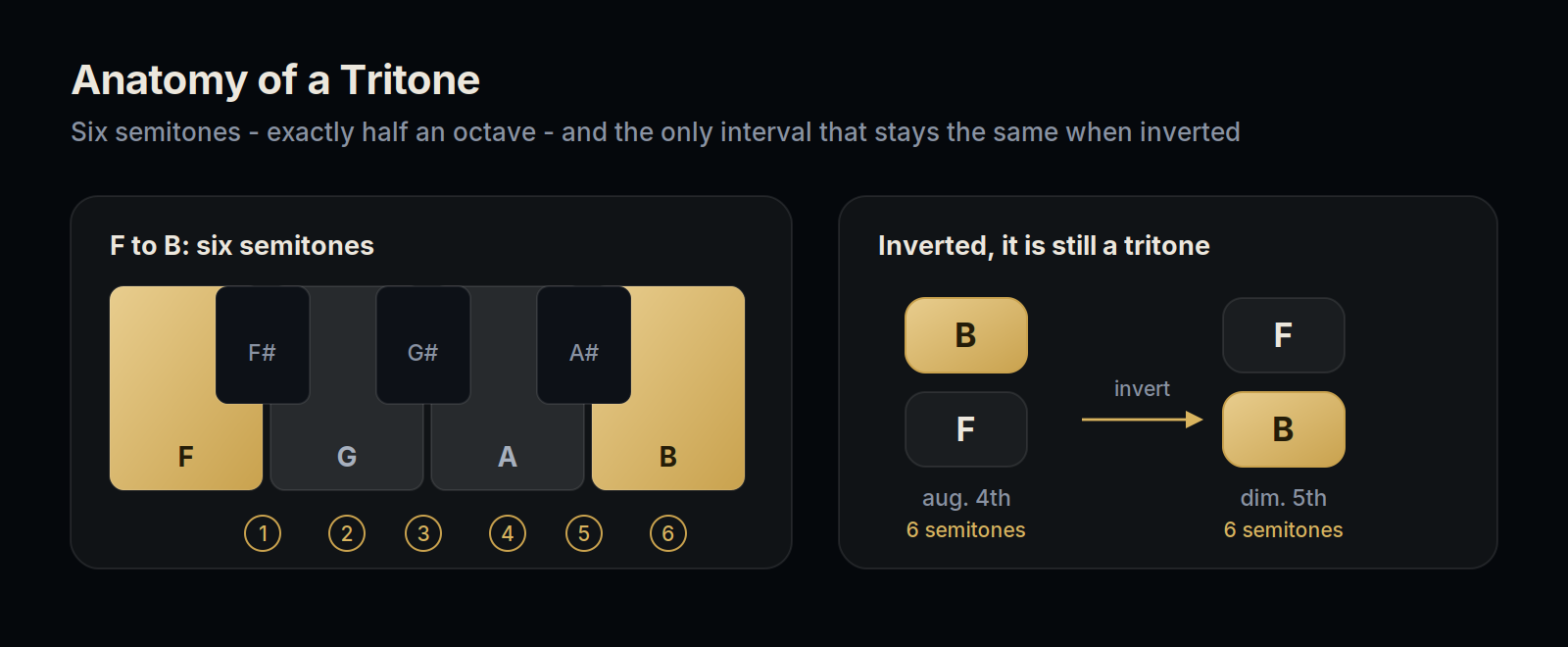
This symmetry is the key that unlocks almost everything else in this article: why dominant chords work the way they do, why diminished chords are ambiguous, and why tritone substitution is possible at all.
Play a tritone on its own and you hear something unstable — a sound that seems to be asking a question. Alongside seconds and sevenths, the tritone belongs to the dissonances: intervals that create friction and want to move somewhere else.
What makes the tritone special among the dissonances is how clearly it points toward its resolution. Take B and F. Each note sits a half step away from a note of the tonic chord in C major: B wants to rise to C, F wants to fall to E. The two voices can resolve inward by a half step on either side. Invert the interval so F is on the bottom, and the same two voices can resolve outward — F down to E, B up to C.
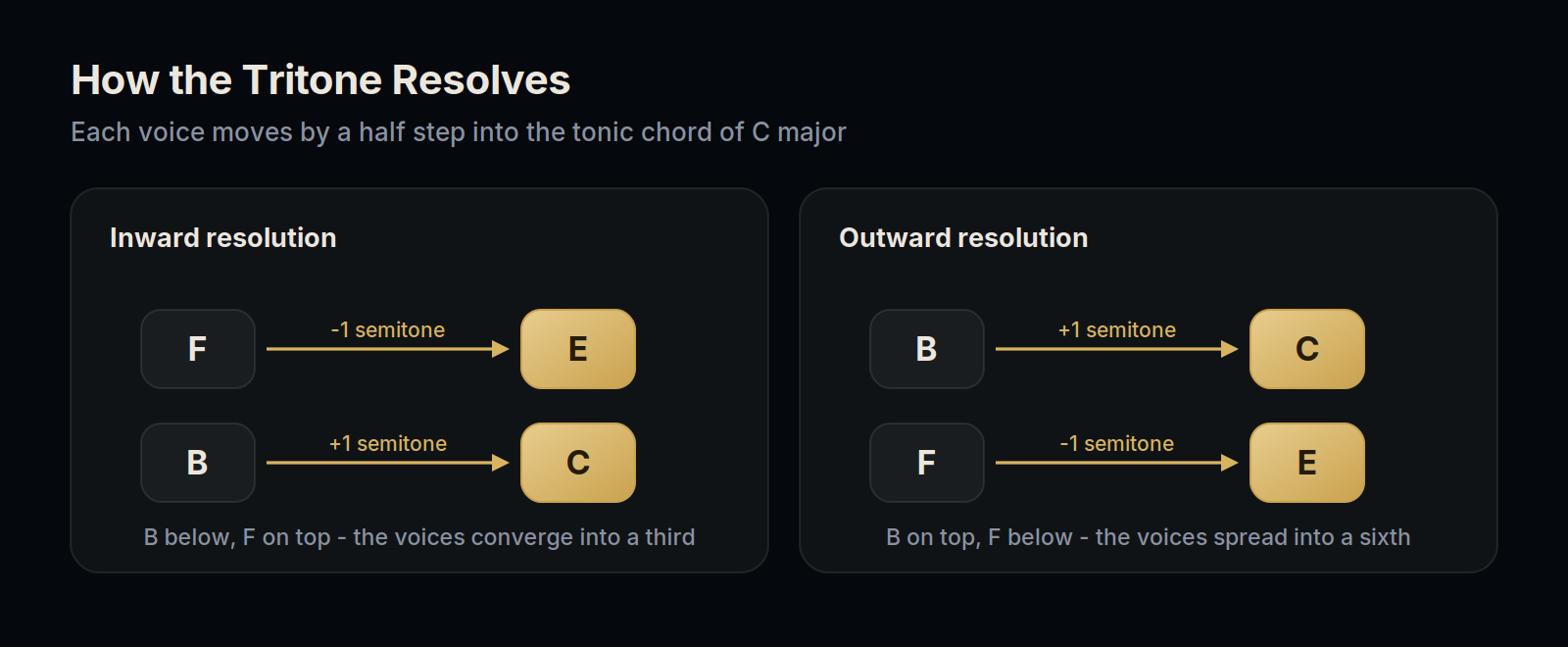
Inward or outward, the destination is the same: the tension of the tritone releases into the stability of the tonic. This tiny two-voice mechanism is the engine inside functional harmony's strongest move.
The nucleus of what gives a G7 chord its character of tension — tension that releases when we land on C — is the tritone formed between its third and seventh, between B and F. Centuries of convention play their part, but the physical pull of those two voices resolving by half step is what makes V7 to I feel so inevitable.
This is worth internalizing as a general principle: whenever a chord contains a tritone, it carries dominant-style tension. Add a minor seventh to an augmented triad — G, B, D#, F — and suddenly the chord feels restless, because the F creates a tritone with the B and the ear starts itching for resolution. The plain augmented triad, without that seventh, feels otherworldly but static by comparison.
The same logic works in reverse. A minor seven flat five chord contains a tritone between its root and flat five — and that is precisely why it cannot function as a tonic. The tritone is unstable, and the whole purpose of a tonic chord is stability. Build a i-mi7b5 from the Locrian mode and it tends to contradict the sense of home you expect from a I chord; it can work, but mostly when you are deliberately going for an extra dark and creepy sound.
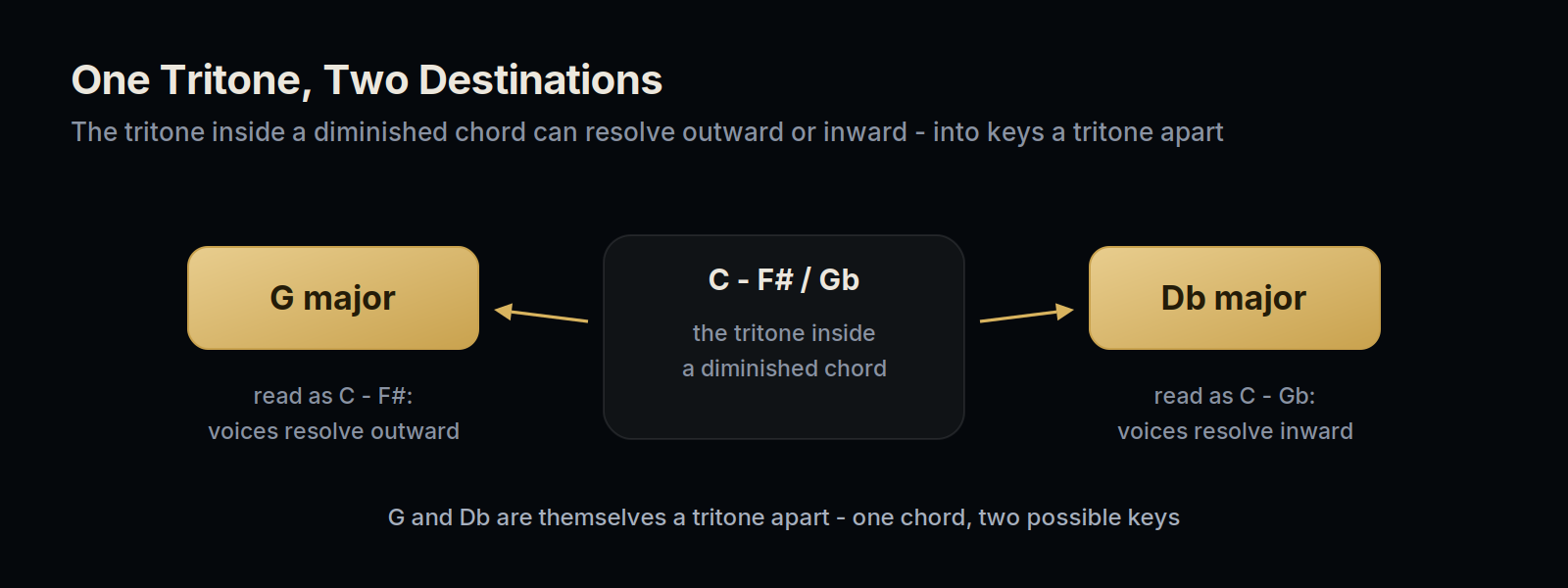
A diminished chord stacks minor thirds, and between its root and flat five sits a tritone. Here the symmetry of the interval becomes a compositional tool. Consider C and F# (or C and Gb — same sound, different spelling). Read it one way and the voices want to resolve outward toward G major; read it the other way and they want to resolve inward toward Db major.
That is part of the magic of diminished chords: the ambiguity of the tritone. You can play with the listener's expectations and flip the polarity — and notice that the two possible destinations, G and Db, are themselves a tritone apart. One chord, two keys, and the listener cannot tell which one is coming.
Tritone substitution is one of those terms that can sound intimidating and turns out to be surprisingly simple once you see the mechanism.
Start from what we established above: the defining tritone of a dominant chord lives between its third and seventh — B and F in a G7. Now ask: is there another dominant seventh chord that contains this same B–F tritone? There is. In a Db7 chord, the third is F and the seventh is B (spelled Cb). The two notes have simply swapped roles.
Stated as a general rule: because the substitution just swaps the roles of the third and seventh, you can take the bass note of any V7 chord and send it down (or up) by a tritone, and the resulting chord retains the same easy voice leading to your target. Instead of G7 to Cmaj7, you play Db7 to Cmaj7 — more tension, and a more dramatic arrival.
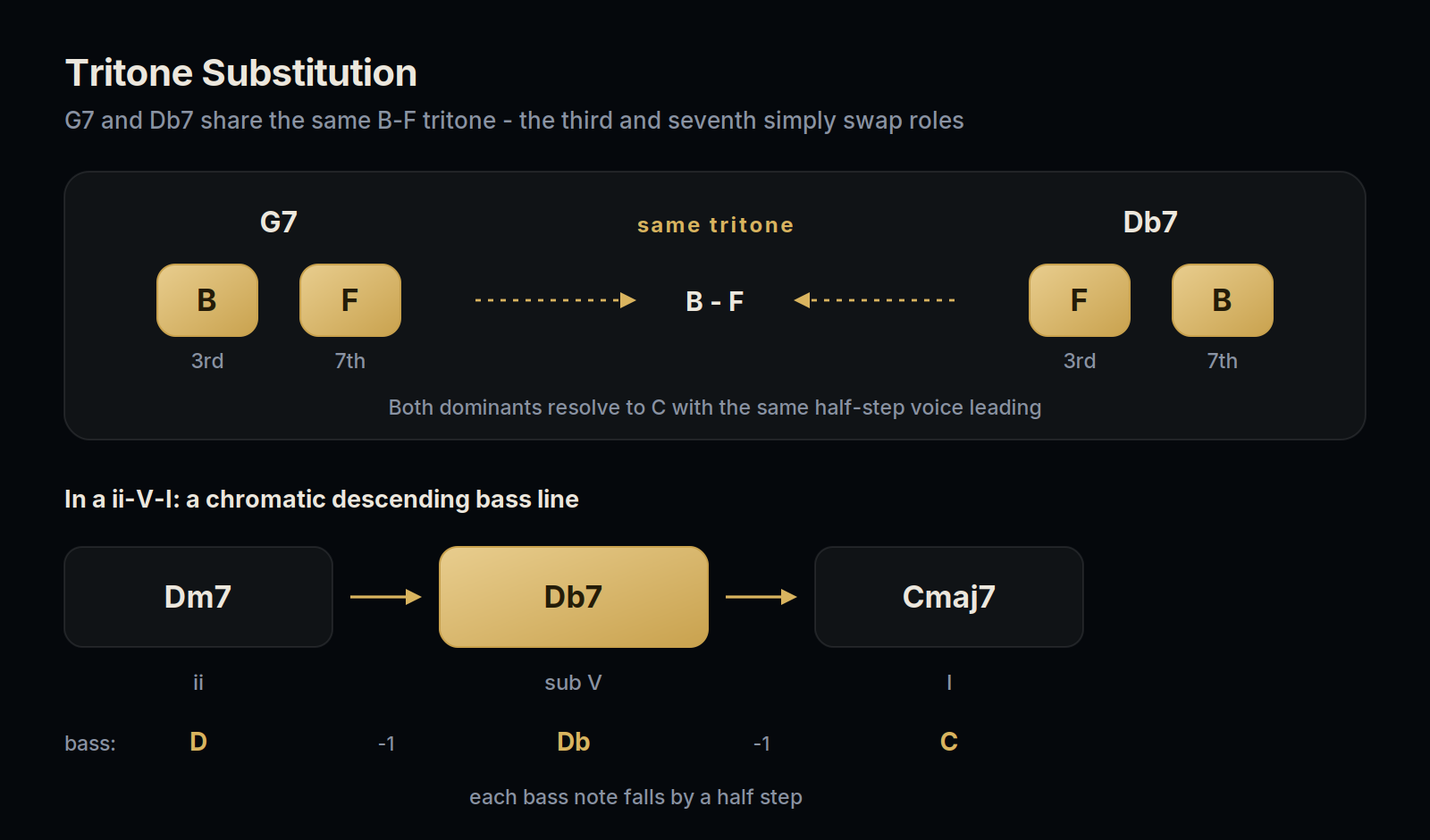
Used inside a ii–V–I, the substitution produces a chromatic descending bass line — Dm7, Db7, Cmaj7 — which is a large part of its appeal. Because the substitute chord resolves down by half step, it is often called a sub five: in C major, Db7 is the sub 5 of C. Sub fives are dominants too, so as long as the melody allows it, you can use one anywhere you would use a secondary dominant — preceding any chord in a progression, not just the final I.
Two practical warnings from the trenches. First, moderation: reharmonizing every other chord with secondary dominants and sub fives will quickly stop sounding cinematic and start sounding like bebop. Second, placement: it is usually better to avoid substituting the structurally important V chords — those are places for a strong, confident moment, not a spicy or ambiguous one. A sub five shines on the smaller waypoints — or in one special role: the "sneaky" ending. Say your piece is in A major, and the final melody note everyone expects is A. Instead of the expected A major chord, place an E-flat major chord underneath — the chord whose root sits a tritone away from the melody note. Because the two are a tritone apart, that melody note is automatically the #4 of the new chord; you never have to check whether it fits, the interval math guarantees it. The listener receives exactly the note they were promised, now glowing with an unexpected Lydian color — the melody lands where it should, and the harmony underneath is the twist.
The Legend of Otoe: Levels 2 & 3 Tritone substitution, altered dominants, and the harmony behind anime and JRPG music, step by step. Explore the course
If you spend time around anime music theory, you will eventually meet the Blackadder chord. The chord itself is closely associated with Japanese composer Hidekazu Tanaka, who uses it frequently; in Japanese theory circles it is known as the bunsū aug — the "slash aug." The English nickname "Blackadder chord" was coined by music theorist Joshua Taipale, who also suggested a more formal name for it: the Japanese augmented sixth chord. For all its mystique, it is essentially a striking voicing of a tritone-subbed dominant.
Here is the recipe. Take the root of your substitute dominant — Db, from our example above. Go a tritone up from that root, landing on G, and build an augmented triad there: Gaug. Play it over the original root and you get Gaug/Db, which resolves beautifully to Cmaj7.
The formal name aligns the chord with classical tradition, which never used the phrase "tritone substitution" but identified several augmented sixth chords by nationality: the German augmented sixth (equivalent to a full tritone-sub dominant), the Italian (the same chord with no fifth), and the French (with a flat five). Same tritone engine, different centuries, different names.
The tritone does not only live inside chords — several scales carry it as their defining color.
Lydian is the friendly one. Its characteristic #4 forms a tritone with the root, yet the mode sounds bright and wondrous rather than sinister, because that #4 pulls upward into the fifth scale degree. This sound has been used extensively in film music — Danny Elfman leans on it often, and the Simpsons theme is a famously Lydian melody.
Locrian is the dark mirror: its flat five puts a tritone right where the stabilizing perfect fifth should be, which is exactly why the mode is so rarely used as an actual key center — and so effective when you want the ground to feel unsafe.
Melodic minor hides a trick. Conventionally you raise the sixth and seventh degrees going up and lower them coming down — but if you deliberately keep the raised degrees in both directions, you expose a tritone in a place the listener does not expect it. A sleight of hand: giving people what they don't expect.
The octatonic scale goes further still. Alternating half and whole steps, it contains multiple tritones and — usefully — real major and minor triads a tritone apart. Moving between F minor and B major, two triads that are both a tritone and a mode apart, produces an odd, fantastical, otherworldly sound, and yet each chord is a perfectly ordinary triad. This is a staple of fantasy and adventure scoring, closely related to chromatic mediants.
Polychords built a tritone apart — say F# major over C major — sit at the dissonant end of the spectrum: dark, mysterious, Herrmann-esque colors that need the right context but deliver enormous atmosphere when they get it.
Because the tritone reads as instability, it has become one of the most reliable dramatic devices in media music.
In thematic writing, the tritone can be a DNA element of a motif — one of the two or three defining features that make a musical idea recognizable, an approach to motif-building we teach step by step in The Piano Composer. Pair a march-like rhythm (regal, assertive) with a tritone leap, and the combined message changes completely: the regality curdles into something unstable, not tonal, almost angry. That emotional fusion — rhythm says one thing, interval says another — is what gives villain and threat motifs their character. Famous danger and villain themes across film history lean on exactly this interval for exactly this reason.
In horror and trailer music, the tritone works alongside its neighbor, the flat 2. Building a theme that pivots between the flat 2 and the tritone instantly establishes a suspenseful, chromatic unease — simple, and immediately effective. Stacked vertically, fourths-based voicings that include an augmented fourth turn a neutral, open sound into something crunchy and threatening; landing from there on an altered dominant such as a 7b9b5 pushes the tension even further.
And sometimes the tritone is a structural device: two key areas a tritone apart are as distant as two keys can be, which makes such a modulation maximally disorienting. That cuts both ways — it is a powerful special effect, and precisely the kind of move to avoid making "just to be clever" in a piece that has not earned it.
Pillars of Composition II Reharmonization with secondary dominants, sub fives, and leading-tone chords is one of the core threads of our advanced composition course. Explore the course
For all its dramatic value, the tritone is an interval you manage carefully in linear writing.
In counterpoint, the tritone is treated as a dissonance alongside seconds and sevenths: it does not appear freely between voices, and when it does appear, it resolves by step. Approaching a tritone in direct motion tends to sound clumsy; approaching it from the opposite direction and letting it resolve reads as intentional and expressive. Handled this way, a passing tritone becomes a lovely crunch rather than a mistake.
In parallel-fourths melody writing — a sound instantly associated with Japanese music — the practical workflow is: duplicate your melody a fourth below, then use your ear. Sometimes the parallel line will produce a tritone or another pitch that sounds off; when it does, simply adjust that note. There is no rule that the lines must stay a perfect fourth apart the whole time.
And in melody generally, a tritone leap is a strong spice. It can be exactly the striking identity a theme needs — or an awkward bump in a line that wants to sing. The difference is intent: a tritone the listener is meant to notice, placed where its instability means something.
For the wider harmonic context these moves live in, see our complete guide to chord progressions for composers.
Our Music Composition & Orchestration Courses
Our Music Production Courses
Our Music Trailer Courses
What is a tritone in simple terms? A tritone is the interval spanning six semitones — exactly half an octave, or three whole tones. F to B is the classic example. It can be spelled as an augmented fourth or a diminished fifth, but both spellings sound the same.
Why is the tritone called the devil's interval? The nickname comes from the Latin phrase diabolus in musica — "the devil in music" — a label that is only documented from around the eighteenth century onward. The popular story that the medieval church banned the tritone (or even excommunicated musicians for singing it) is a myth: the interval appears in medieval sacred music, including works by the thirteenth-century composer Pérotin. What is true is that early counterpoint treated the tritone as a harsh dissonance to be handled with care — and that reputation for instability is exactly why film and metal composers still love it today.
Is a tritone the same as an augmented fourth? Yes, in sound. An augmented fourth (F up to B) and a diminished fifth (B up to F) both span six semitones and are enharmonically the same interval. The spelling you choose usually depends on the key and the direction of resolution.
Why does a dominant seventh chord contain a tritone? The third and seventh of any dominant seventh chord — B and F in a G7 — are a tritone apart. That pair is the source of the chord's tension: each note resolves by half step into the tonic chord, which is why V7 pulls so strongly toward I.
What is tritone substitution? Tritone substitution replaces a dominant seventh chord with the dominant seventh whose root lies a tritone away — Db7 instead of G7, for example. Both chords share the same defining tritone (B and F, with the roles of third and seventh swapped), so the substitute resolves just as smoothly while adding a chromatic, dramatic color. It is also called a sub five.
What is the Blackadder chord? The Blackadder chord is an augmented triad played over a bass note a tritone away from its root, such as Gaug/Db resolving to Cmaj7. The chord is closely associated with Japanese composer Hidekazu Tanaka, who uses it frequently; the English nickname was coined by music theorist Joshua Taipale, who also proposed the more formal name Japanese augmented sixth chord. Functionally it is a distinctive voicing of a tritone-substituted dominant, and it is a beloved color in anime harmony.
Does the tritone always sound scary? No. Context decides everything. Inside a Lydian melody the tritone sounds bright and full of wonder; inside a dominant chord it sounds like ordinary tension seeking release; exposed in a horror cue it sounds menacing. The interval supplies instability — the composer decides what that instability means.
Learn with Master The Score
Courses on composition, orchestration, music production, trailer music and sound design, from composers writing for film, games and media. Students also get exclusive discounts on leading sample libraries and plugins.
Discover all courses →


Online education for media composers — orchestral writing, trailer music, mixing and more, taught by working professionals.