
Music Theory and Composition
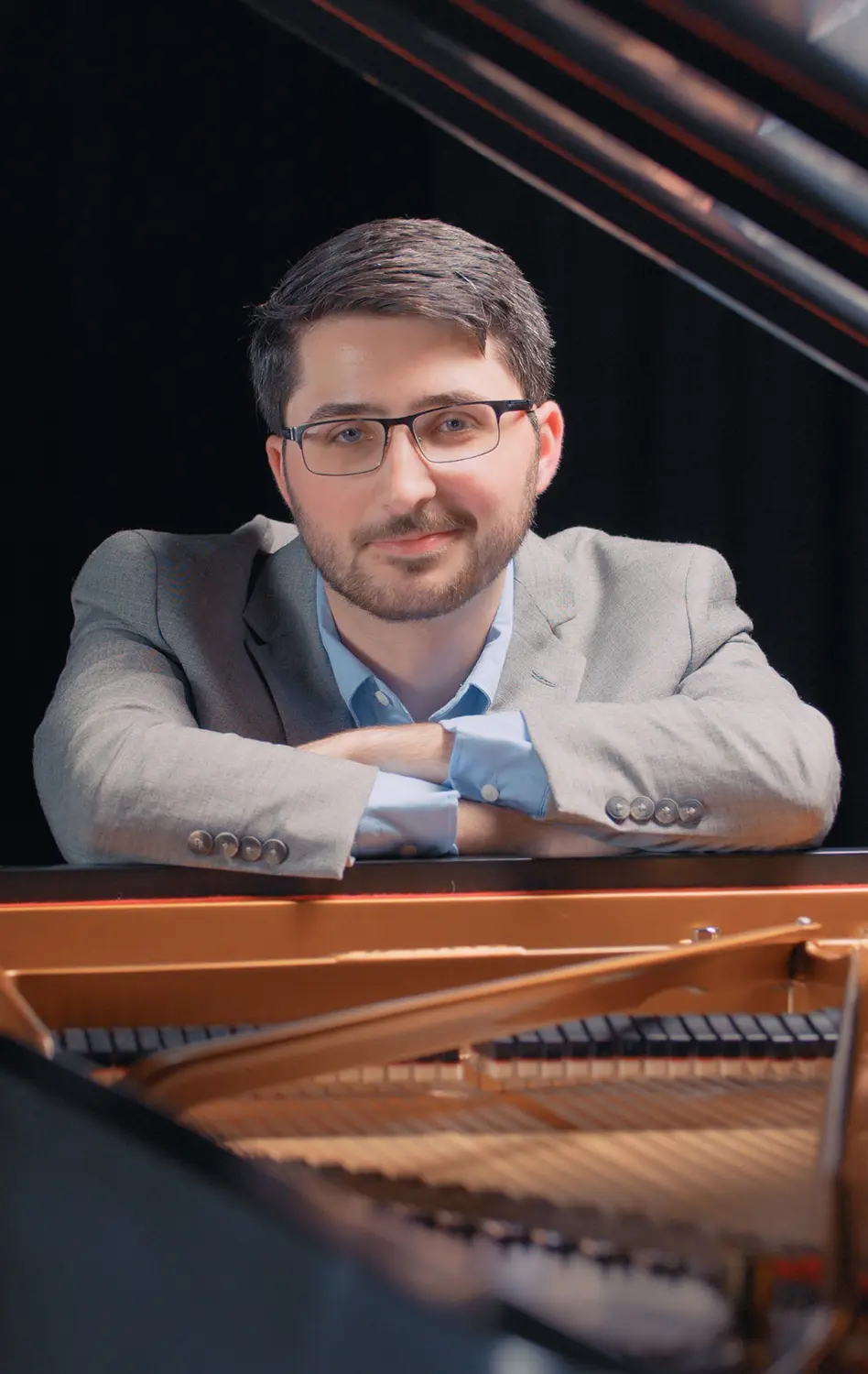
David McCaulley is a pianist and composer known for his YouTube channel Film Score Analysis, home to more than 150 score reductions of iconic film scores. He studied composition and piano at the University of North Texas and teaches The Piano Composer at Master The Score.
A leitmotif is one of the most useful ideas a composer can work with: a short, recognizable musical idea that stands for a character, a place, an object, or an idea, and returns throughout a score. This guide explains what a leitmotif is, how it differs from a plain motif, why the technique works so well in film, game, and stage music, and how to write and develop your own.
The material is drawn from the Master The Score curriculum, specifically The Piano Composer, where motif writing is the starting point for everything that follows.
A leitmotif (from the German Leitmotiv, "leading motif") is a short musical idea that is deliberately associated with something outside of the music: a person, a thing, a place, an idea, or even a narrative subtext that the audience is not told about directly. Every time that person or idea becomes relevant to the story, the motif can return, and because the idea is short and recognizable, listeners can connect it to its subject, often without consciously noticing.
The concept is usually traced back to Richard Wagner and the late-Romantic composers around him. Wagner's Ring cycle assigns motifs to characters, objects, and ideas, and transforms them as the drama unfolds. Film composers inherited the technique almost directly, which is why the word leitmotif today appears far more often in discussions of film and game scores than of opera.
Here are three very practical aspects to consider:
These two words are often used as if they meant the same thing, but there is a slight difference that separates them.
A motif is any short musical idea with an identity of its own. It doesn't represent anything. It could be something like the opening four notes of a symphony, a rhythmic figure in a bass line, or a two-chord movement that keeps returning. All of these are motifs, and every piece of music is full of them. But, outside of its own musical context, it doesn't mean anything.
A leitmotif is a motif with a job. It is tied to a person, place, thing, or idea, and it is used to signal that subject's presence or relevance. All leitmotifs are motifs; only some motifs are leitmotifs.
In practice, composers tend to say "motif" for the small musical building block and "theme" for the longer melody built from it, and only specify a "leitmotif" when they want to stress the dramatic association. In our courses you will hear "motif" far more often than "leitmotif", but the craft of writing one is identical either way. If you can write a strong motif, you can write a leitmotif. Turning a motif into a leitmotif is a decision you make when you use it to represent something outside the music.
When people think of a motif, they usually think of a melody first. A motif can be built from almost any aspect of music, and this is what gives the leitmotif its immense range of usefulness.
Spend some time really considering this list. Are there any specific examples you can think of for each of these types? How would you go about creating one of these types? Better yet, how can these types be transformed to fit the need of a story? For example, if a character already has a melodic motif, the reveal of a darker side of theirs might prompt a composer to give them a minor-sounding harmonic motif too. Perhaps the melodic and harmonic motifs are built to work both separately and together. Or perhaps a film score requires a more subtle musical touch, so a person or place might be represented by a texture rather than a more obvious tune. A score built from several kinds of motif, especially ones that work together and build off of each other, tends to feel richer than one built from melodies alone.
The Piano Composer Motif writing is where the course begins, and every later chapter grows out of it. Explore the course
Not every short idea works as a leitmotif. The ones that are truly memorable share a handful of qualities, and it's important to check a new idea against them.
The most useful way to understand a motif is to take it apart and look at what it is made of. For example, take a motif that consists of two elements: a stately, march-like rhythm and a tritone, the interval of an augmented fourth. Those two elements are its DNA. Fuse them and you have a short, identifiable, recognizable idea.
Looking at a motif this granularly also tells you what it means emotionally. The rhythm on its own suggests something regal, a march. The tritone on its own is unstable, not quite tonal, almost angry. Put those together, and the motif is a rather on-the-nose march with menace in it. But change one element, say the tritone to a perfect fourth, and the same rhythm suddenly feels far more stable and open; the character has changed without the rhythm changing at all.
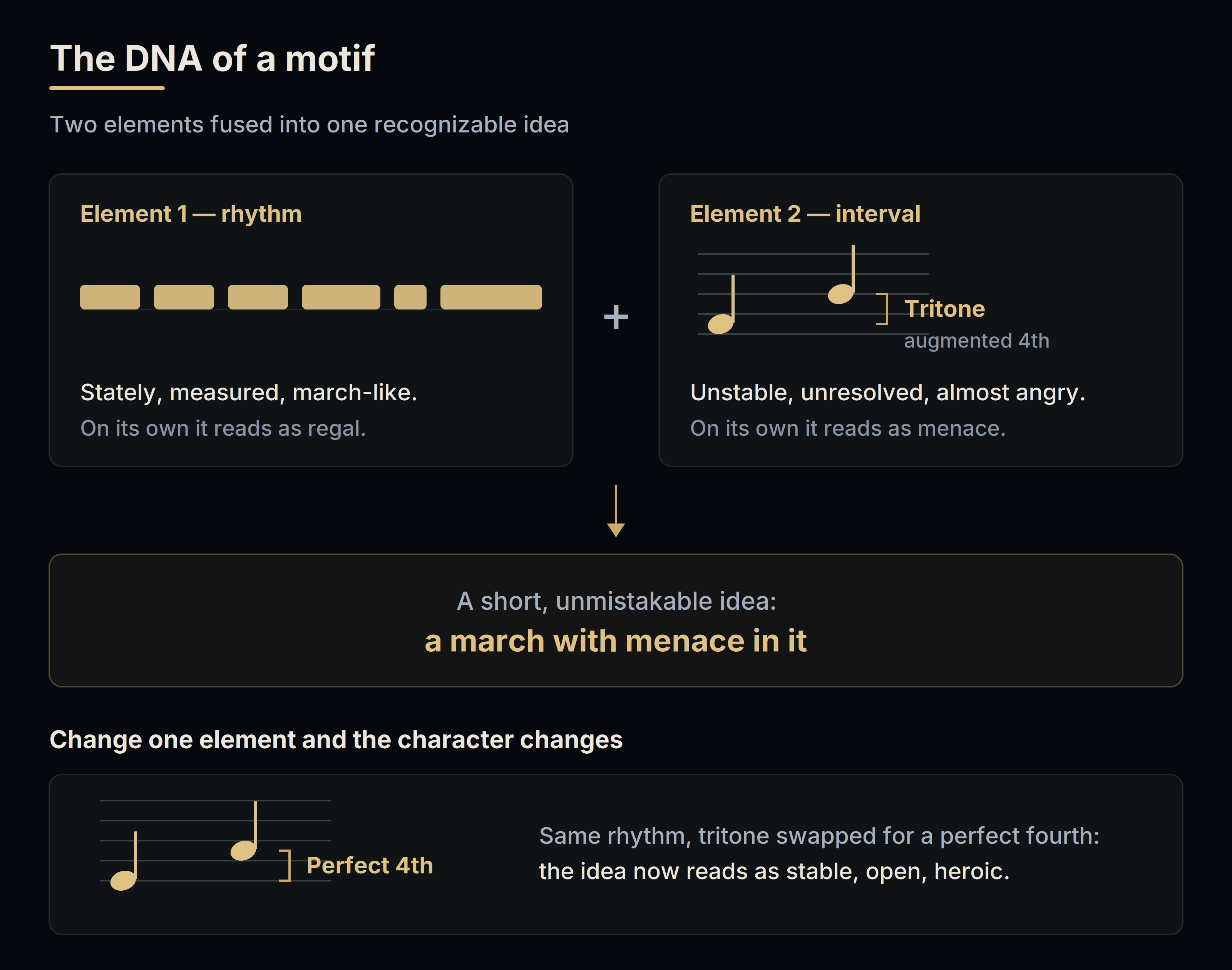
This is why it is so important to ask, for every element of a motif, not only how it sounds but how it feels. Interval, rhythm, contour, register, and timbre all carry emotional information, and a leitmotif works best when its DNA elements point in the same direction as the character or idea it represents. Strong intervals such as perfect fourths and fifths tend to read as bold and heroic, which is why they appear so often in themes for warriors and adventurers; half-steps and minor sixths lean toward menace and lyric darkness.
A good exercise is to take well-known film motifs and identify their DNA elements: the rhythm, the intervals, the chord changes, the instrument they are played by, or even the meter they sit in. Here are some worth studying.
For longer themes, Hedwig's Theme from Harry Potter and the solo-trumpet theme from Apollo 13 are also great examples of how a theme is built from smaller motifs, which are in turn built from smaller DNA elements. In each case, try to deconstruct what the basic ideas are (the intervals, rhythms, chords, etc.), how they are repeated, and how they are transformed.
Leitmotifs are powerful for a simple reason: they are recognizable, and people latch onto recognizable things, often subconsciously. When a motif is tied to a character, and the character is compelling, the audience begins to feel the character's presence whenever the motif appears, even before anything happens on screen.
This creates possibilities that a single memorable theme cannot. A motif can appear in a different key to suggest that a character has changed. It can be inverted, slowed down, or moved to a dark instrument as the story turns. Two motifs can be combined when two characters meet. A fragment can be hidden in an accompaniment to hint at something the characters do not yet know. Over the length of a film or a game, this builds an intricate and emotionally powerful score out of a small number of very simple ideas. Even in a modern stylistic context where subtlety is king, motifs can be used in simple ways to convey complex ideas.
The same logic applies in trailer music, where the leitmotif idea appears under a different name. A trailer track is usually built around a short, singable signature motif, sometimes only two or three notes over a pedal, which the whole track develops and which is often handed to the editor as a separate part because it is the thing people will remember. The word is "hook" rather than "leitmotif", but the idea is the same.
Here is a method that works well at the piano, and just as well in a DAW.
Pillars of Composition Melody, harmony, accompaniment and counterpoint, including the sentence and period forms that turn a motif into a theme. Explore the course
Writing the motif is the smaller part of the job. A leitmotif earns its value through development, and there is a reliable set of tools for that.
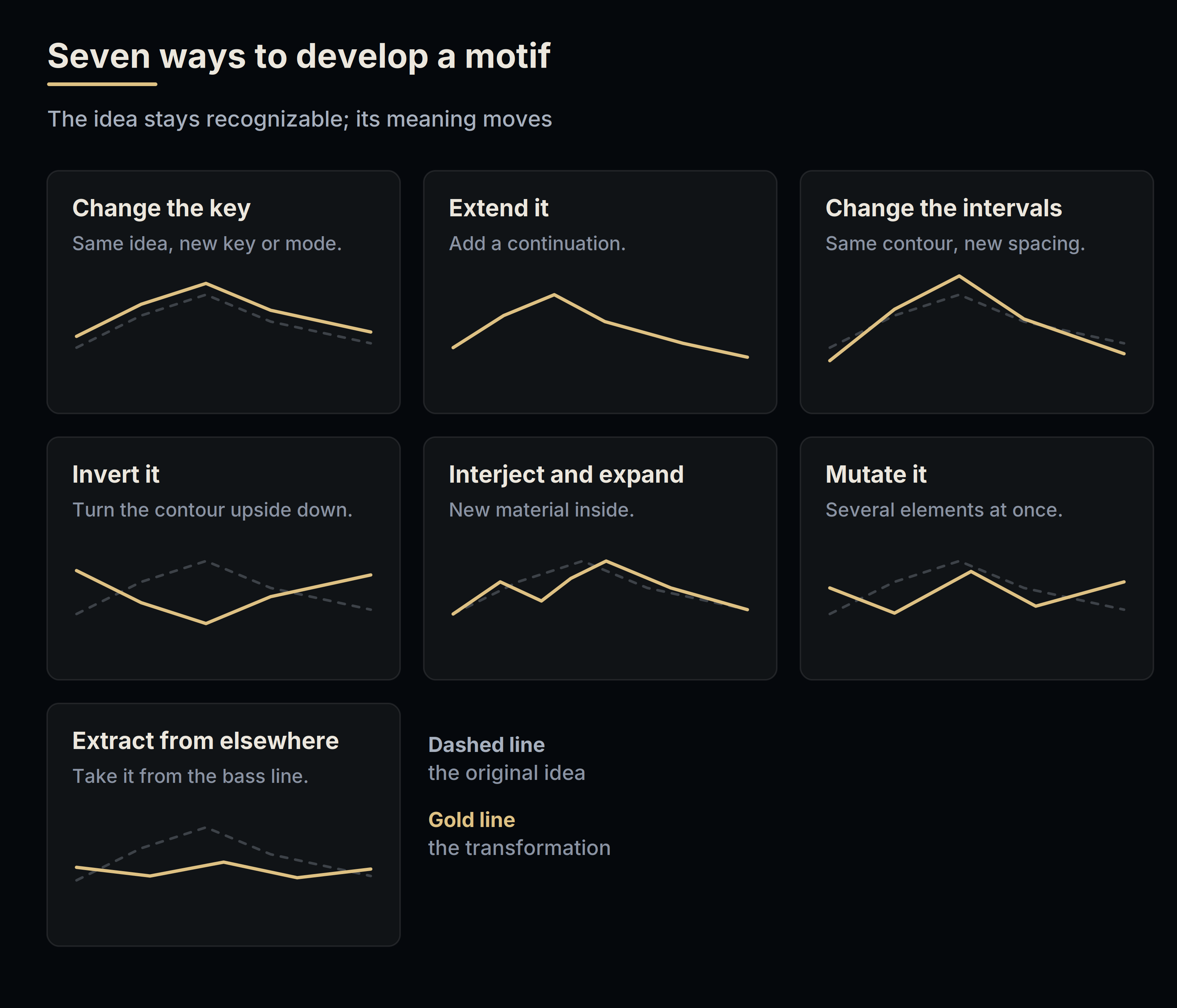
All of these tools raise the same question: how do you keep track of the material, and how do you make sure you actually generate enough of it? There is a method for that, taught in Chapter 4 of The Piano Composer, and it deserves a mention here because of how reliably it works. It was passed on to me by a composition teacher who also worked as a Hollywood composer, and it is called the family tree.
The idea is simple. A single motif, written at the top of a blank sheet of staff paper, becomes the ancestor of an entire family of related ideas: each child is a particular kind of variation on the original, each grandchild one step further away, and every one of them still carries the original DNA. What makes the method work is not the diagram itself but the freedom in how each branch is allowed to change. When you let the mind organically fill in this tree, it is close to impossible to get stuck, which is why it doubles as one of the most dependable cures for writer's block I know. Composers who use it can finish a session with a full page of usable, related material from one idea. Some or all of these can be used as the raw material for an entire cue.
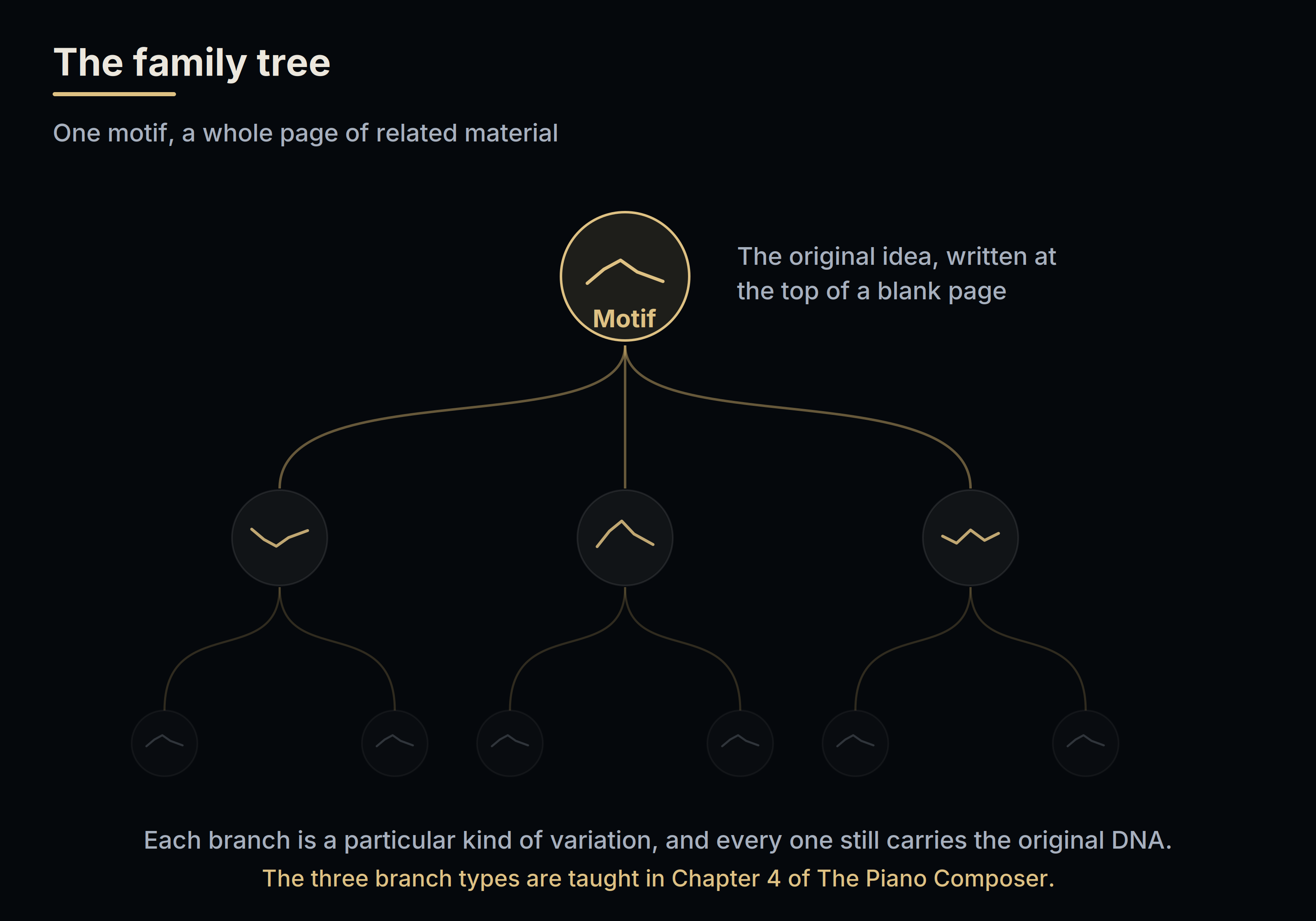
The complete walkthrough, including the three branch types and how the resulting material is turned into a finished hero theme, is in The Piano Composer.
A leitmotif is not finished when it is written; it also has to be heard. In an orchestral mockup, a motif often begins as a single line in a piano sketch and is then assigned to the section that suits its character: a lone trumpet for a fanfare idea, layered horns for weight, a call-and-answer between flute and oboe an octave apart in a woodwind quartet. A rhythmic motif taken from a bass line can be answered by a different instrument later in the piece; a repeated motif can be given a modulation to keep the listener's attention when the idea itself stays the same.
The important thing is to keep the DNA intact through orchestration. If the identity of the motif lives in a tritone and a march rhythm, the orchestration should make those two things audible, whatever else is happening around them.
Our Music Composition & Orchestration Courses
Our Music Production Courses
Our Music Trailer Courses
What does leitmotif mean? Leitmotif comes from the German Leitmotiv, "leading motif". It is a short, recognizable musical idea associated with a particular character, place, object, or idea, which returns whenever that subject becomes relevant.
What is the difference between a motif and a leitmotif? A motif is any short musical idea with its own identity. A leitmotif is a motif that has been deliberately associated with something in a story. Every leitmotif is a motif, but a motif only becomes a leitmotif through that association.
Who invented the leitmotif? The technique is most closely associated with Richard Wagner, whose Ring cycle uses motifs for characters, objects, and ideas and transforms them across the drama. Earlier composers used recurring themes too, but Wagner made the technique systematic, and film composers adopted it from him.
Can a leitmotif be a rhythm or a chord rather than a melody? Yes. A motif can be melodic, harmonic, rhythmic, textural, metric, or based on timbre. Any aspect of music can be singled out to create a striking motif.
How long should a leitmotif be? Usually a few notes, a short rhythm, or a single chord movement. Short ideas are easier to remember, easier to repeat, and easier to transform, which is the whole point.
How do I develop a leitmotif over a whole score? Change its key or mode, extend it, alter its intervals while keeping its contour, invert it, add interjections or expansions, or mutate several elements at once. The family tree method, writing a motif and branching variations from it on staff paper, is a practical way to generate this material in advance.
Is a leitmotif the same as a theme? Not quite. A theme is a complete melody, often built in sentence or period form. A leitmotif is usually shorter, and a theme is often made from one or more motifs. A theme can function as a leitmotif if it is associated with a character, but the shorter the idea, the more flexibly it can be used.
Learn with Master The Score
Courses on composition, orchestration, music production, trailer music and sound design, from composers writing for film, games and media. Students also get exclusive discounts on leading sample libraries and plugins.
Discover all courses →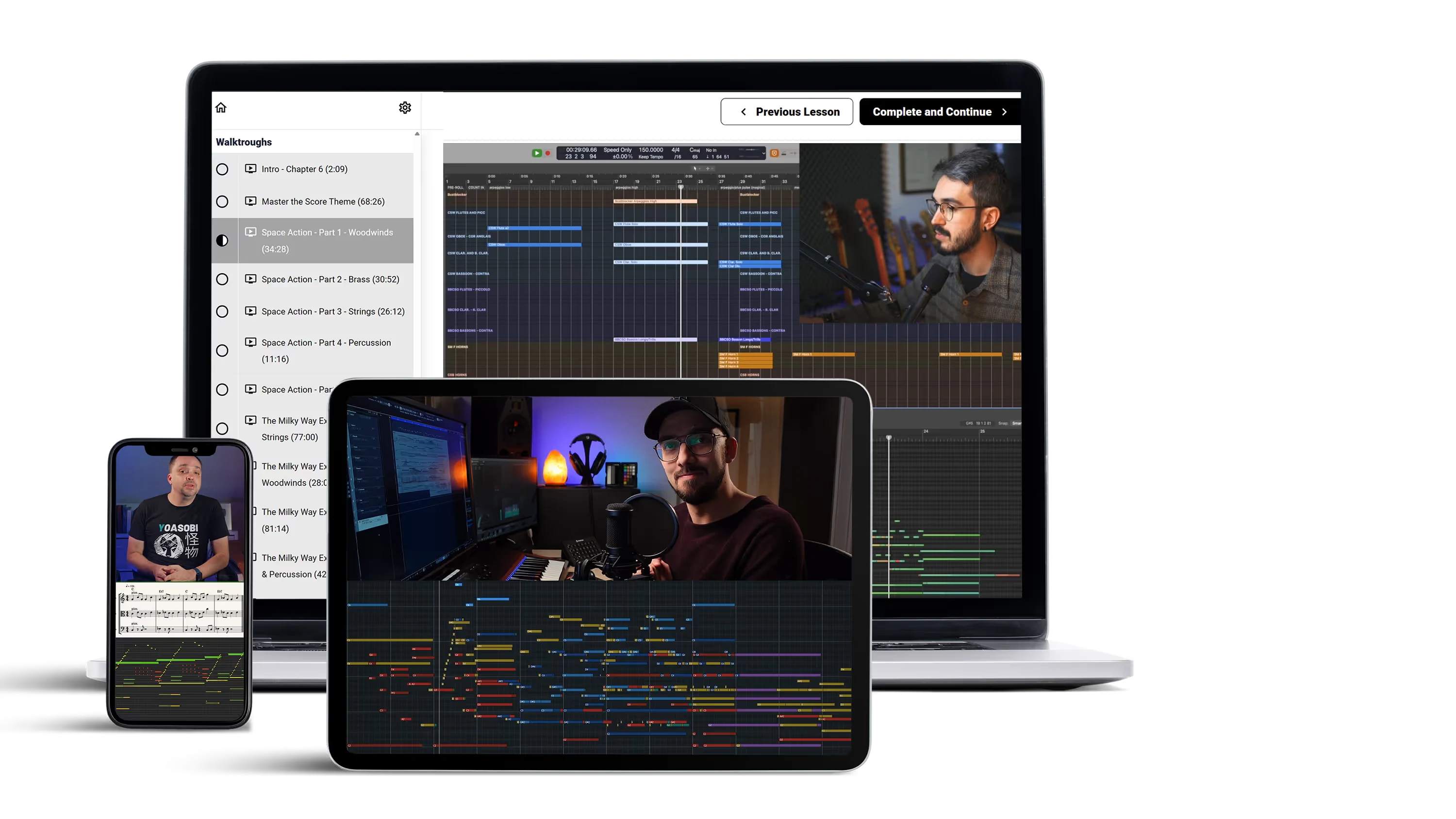
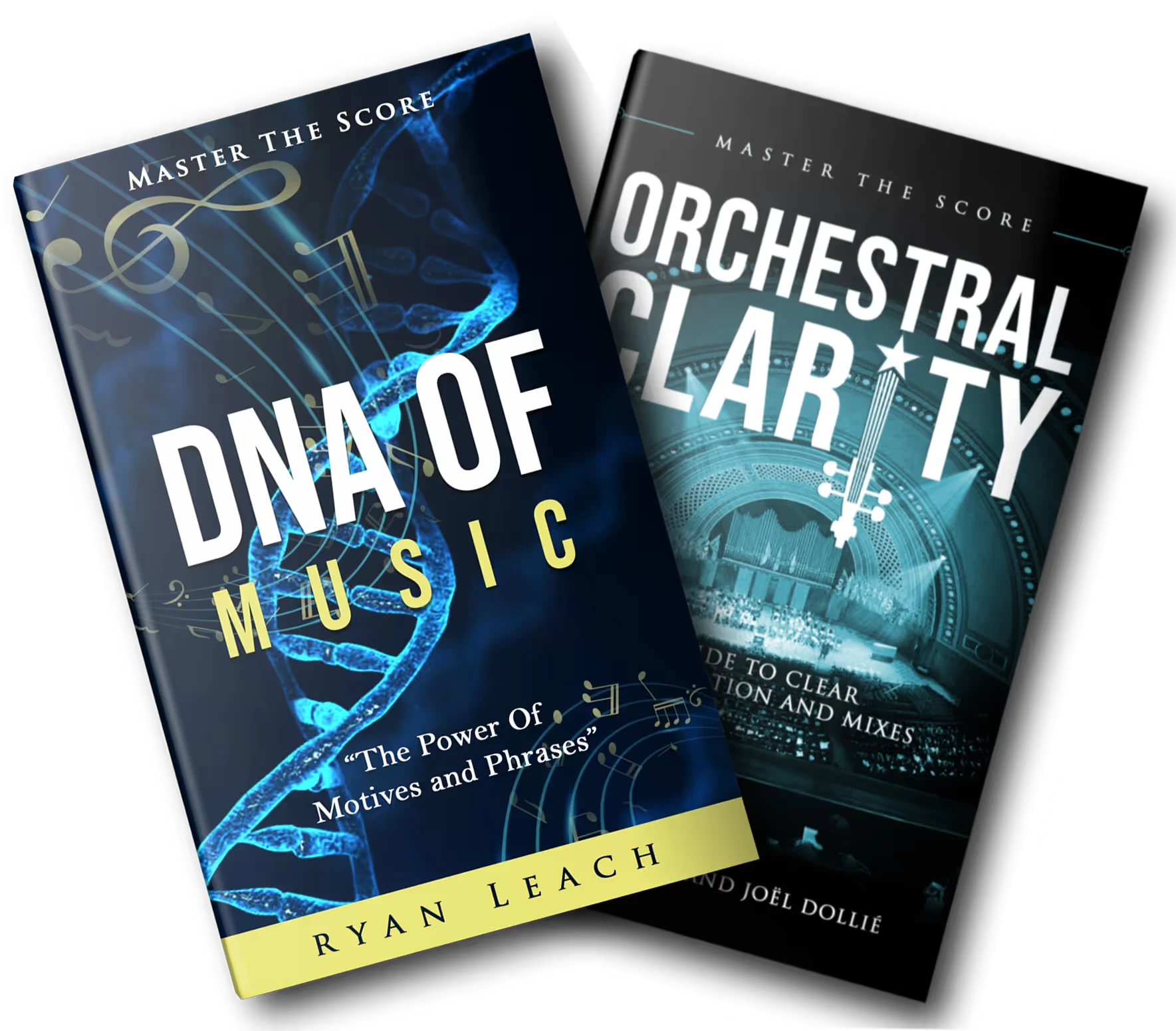

Online education for media composers — orchestral writing, trailer music, mixing and more, taught by working professionals.